As the name suggests the GROUP BY clause in MySQL groups the data together. The FROM and WHERE clause creates an intermediate tabular result set and the GROUP BY clause systematically groups the data. The GROUP BY clause can group the result set by one or more columns. That means the Group by Clause divides the similar type of records or data as a group and then returns. If we use group by clause in the query then we should use grouping/aggregate function such as count(), sum(), max(), min(), avg() functions.

The GROUP BY clause groups the selected rows based on identical values in a column or expression. This clause is typically used with aggregate functions to generate a single result row for each set of unique values in a set of columns or expressions. Expression_n Expressions that are not encapsulated within an aggregate function and must be included in the GROUP BY Clause at the end of the SQL statement. Aggregate_function This is an aggregate function such as the SUM, COUNT, MIN, MAX, or AVG functions.

Aggregate_expression This is the column or expression that the aggregate_function will be used on. These are conditions that must be met for the records to be selected. If more than one expression is provided, the values should be comma separated. DESC sorts the result set in descending order by expression. The GROUP BY clause groups together rows in a table with non-distinct values for the expression in the GROUP BY clause. For multiple rows in the source table with non-distinct values for expression, theGROUP BY clause produces a single combined row.

GROUP BY is commonly used when aggregate functions are present in the SELECT list, or to eliminate redundancy in the output. The GROUP BY clause groups a set of rows into a set of summary rows by values of columns or expressions. In other words, it reduces the number of rows in the result set. In this syntax, you place the GROUP BY clause after the FROM and WHERE clauses.

The GROUP BY Clause is used together with the SQL SELECT statement. The SELECT statement used in the GROUP BY clause can only be used contain column names, aggregate functions, constants and expressions. SQL Having Clause is used to restrict the results returned by the GROUP BY clause. The SQL GROUP BY Statement The GROUP BY statement groups rows that have the same values into summary rows, like "find the number of customers in each country". The GROUP BY statement is often used with aggregate functions (COUNT (), MAX (), MIN (), SUM (), AVG ()) to group the result-set by one or more columns. ROLLUP is an extension of the GROUP BY clause that creates a group for each of the column expressions.

Additionally, it "rolls up" those results in subtotals followed by a grand total. Under the hood, the ROLLUP function moves from right to left decreasing the number of column expressions that it creates groups and aggregations on. Since the column order affects the ROLLUP output, it can also affect the number of rows returned in the result set.

The Group by clause is often used to arrange identical duplicate data into groups with a select statement to group the result-set by one or more columns. This clause works with the select specific list of items, and we can use HAVING, and ORDER BY clauses. Group by clause always works with an aggregate function like MAX, MIN, SUM, AVG, COUNT. This syntax allows users to perform analysis that requires aggregation on multiple sets of columns in a single query. Complex grouping operations do not support grouping on expressions composed of input columns. It is not permissible to include column names in a SELECT clause that are not referenced in the GROUP BY clause.

The only column names that can be displayed, along with aggregate functions, must be listed in the GROUP BY clause. Since ENAME is not included in the GROUP BYclause, an error message results. You often use the GROUP BY clause with aggregate functions such as SUM, AVG, MAX, MIN, and COUNT. The aggregate function that appears in the SELECT clause provides information about each group. The GROUP BY clause is a SQL command that is used to group rows that have the same values.

Optionally it is used in conjunction with aggregate functions to produce summary reports from the database. The GROUP BY clause is often used with aggregate functions such as AVG(), COUNT(), MAX(), MIN() and SUM(). In this case, the aggregate function returns the summary information per group.

For example, given groups of products in several categories, the AVG() function returns the average price of products in each category. In the result set, the order of columns is the same as the order of their specification by the select expressions. If a select expression returns multiple columns, they are ordered the same way they were ordered in the source relation or row type expression. It filters non-aggregated rows before the rows are grouped together. To filter grouped rows based on aggregate values, use the HAVING clause.

The HAVING clause takes any expression and evaluates it as a boolean, just like the WHERE clause. As with the select expression, if you reference non-grouped columns in the HAVINGclause, the behavior is undefined. The GROUP BY clause is used in a SELECT statement to group rows into a set of summary rows by values of columns or expressions.

In the Group BY clause, the SELECT statement can use constants, aggregate functions, expressions, and column names. When using the GROUP BY clause, you can group by expressions , columns, alias names, or functions. The result of the query contains one row for each distinct value of each grouping set.

The condition in the HAVING clause changed the department average salary more than $70,000. So, the expression used in the HAVING statement is a summary function. The code selects the column Department and uses the summary function AVG() to compute the average salaries.

Since the GROUP BY clause also is also present in the SELECT statement, the averages are for each department. The user is only interested in three departments, Law, Finance and Fire. So we use the HAVING clause to select only these three to be output.

This program contains every clause we have learned so far except the WHERE clause, which we will address later. Adding a HAVING clause after your GROUP BY clause requires that you include any special conditions in both clauses. If the SELECT statement contains an expression, then it follows suit that the GROUP BY and HAVING clauses must contain matching expressions.

It is similar in nature to the "GROUP BY with an EXCEPTION" sample from above. In the next sample code block, we are now referencing the "Sales.SalesOrderHeader" table to return the total from the "TotalDue" column, but only for a particular year. Like most things in SQL/T-SQL, you can always pull your data from multiple tables. Performing this task while including a GROUP BY clause is no different than any other SELECT statement with a GROUP BY clause.
The fact that you're pulling the data from two or more tables has no bearing on how this works. In the sample below, we will be working in the AdventureWorks2014 once again as we join the "Person.Address" table with the "Person.BusinessEntityAddress" table. I have also restricted the sample code to return only the top 10 results for clarity sake in the result set.

What Is The Use Of Group By And Having Clause In Sql The SUM() function returns the total value of all non-null values in a specified column. Since this is a mathematical process, it cannot be used on string values such as the CHAR, VARCHAR, and NVARCHAR data types. When used with a GROUP BY clause, the SUM() function will return the total for each category in the specified table. The ORDER BY clause specifies a column or expression as the sort criterion for the result set.

If an ORDER BY clause is not present, the order of the results of a query is not defined. Column aliases from a FROM clause or SELECT list are allowed. If a query contains aliases in the SELECT clause, those aliases override names in the corresponding FROM clause. The aggregate functions allow you to perform the calculation of a set of rows and return a single value. The GROUP BY clause is often used with an aggregate function to perform calculations and return a single value for each subgroup.

Aggregate functions are functions that take a set of rows as input and return a single value. In SQL we have five aggregate functions which are also called multirow functions as follows. Optionally it is used in conjunction with aggregate functions to produce the resulting group of rows from the database. SQL allows the user to store more than 30 types of data in as many columns as required, so sometimes, it becomes difficult to find similar data in these columns. Group By in SQL helps us club together identical rows present in the columns of a table. This is an essential statement in SQL as it provides us with a neat dataset by letting us summarize important data like sales, cost, and salary.

However, you can use the GROUP BY clause with CUBE, GROUPING SETS, and ROLLUP to return summary values for each group. Here, you can add the aggregate functions before the column names, and also a HAVING clause at the end of the statement to mention a condition. Such kind of query is called subquery, inner query or nested query. You can use this query-expression in a HAVING or WHERE clause. The subquery used in this example is to calculate the overall average salary. The result is compared with average salaries of each department.

Then SAS evaluates the condition "Less than" in HAVING clause to select departments who have less average salaries to output. FILTER is a modifier used on an aggregate function to limit the values used in an aggregation. All the columns in the select statement that aren't aggregated should be specified in a GROUP BY clause in the query. Another extension, or sub-clause, of the GROUP BY clause is the CUBE.

The CUBE generates multiple grouping sets on your specified columns and aggregates them. In short, it creates unique groups for all possible combinations of the columns you specify. For example, if you use GROUP BY CUBE on of your table, SQL returns groups for all unique values , , and . IIt is important to note that using a GROUP BY clause is ineffective if there are no duplicates in the column you are grouping by. A better example would be to group by the "Title" column of that table.
The SELECT clause below will return the six unique title types as well as a count of how many times each one is found in the table within the "Title" column. A subquery with a recursive table reference cannot invoke aggregate functions. The INTERSECT operator returns rows that are found in the result sets of both the left and right input queries. Unlike EXCEPT, the positioning of the input queries does not matter. Corner cases exist where a distinct pivot_columns can end up with the same default column names.

For example, an input column might contain both aNULL value and the string literal "NULL". When this happens, multiple pivot columns are created with the same name. To avoid this situation, use aliases for pivot column names. SELECT AS STRUCT can be used in a scalar or array subquery to produce a single STRUCT type grouping multiple values together. Scalar and array subqueries are normally not allowed to return multiple columns, but can return a single column with STRUCT type. HAVING Clause is used as a conditional statement with GROUP BY Clause in SQL.

WHERE Clause cannot be combined with aggregate results so Having clause is used which returns rows where aggregate function results matched with given conditions only. The GROUP BY clause divides the rows returned from the SELECTstatement into groups. For each group, you can apply an aggregate function e.g.,SUM() to calculate the sum of items or COUNT()to get the number of items in the groups.

Each grouping set defines a set of columns for which an aggregate result is computed. The final result set is the set of distinct rows from the individual grouping column specifications in the grouping sets. GROUPING SETS syntax can be defined over simple column sets or CUBEs or ROLLUPs.

In effect, CUBE and ROLLUP are simply short forms for specific varieties of GROUPING SETS. CUBE generates the GROUP BY aggregate rows, plus superaggregate rows for each unique combination of expressions in the column list. A simple GROUP BY clause consists of a list of one or more columns or expressions that define the sets of rows that aggregations are to be performed on.
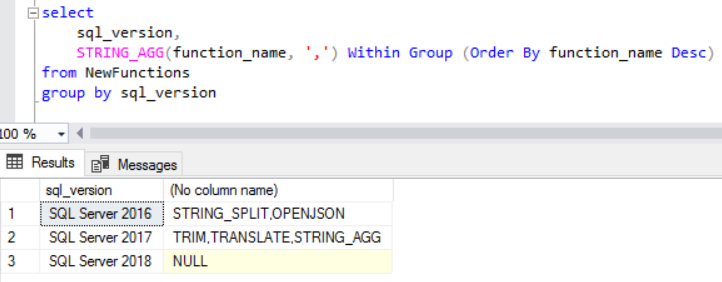
A change in the value of any of the GROUP BY columns or expressions triggers a new set of rows to be aggregated. This statement is used to group records having the same values. The GROUP BY statement is often used with the aggregate functions to group the results by one or more columns. In this query, all rows in the EMPLOYEE table that have the same department codes are grouped together. The aggregate function AVG is calculated for the salary column in each group. The department code and the average departmental salary are displayed for each department.

The GROUP BY clause is normally used along with five built-in, or "aggregate" functions. These functions perform special operations on an entire table or on a set, or group, of rows rather than on each row and then return one row of values for each group. As an extension Texis also allows the GROUP BY clause to consist of expressions instead of just column names. This should be used with caution, and the same expression should be used in the SELECT as in the GROUP BY clause. This is especially true if the expression will fold multiple values together, such as dividing a number by 1000 to group quantities together if they are in the same 1000.